ABCDE (Attention Based Cell Detection Enhancer)
Lunit Inc.Advisor: Jaewoong Shin, Dr. Sergio Pereira
Dec 2023 - Feb 2024
Project Overview
Project Goal
The goal of this project is to improve cell detection results by incorporating relationships between cells, beyond just detecting individual cells. By considering both positional information and feature similarity, the model more accurately represents cellular interactions.
Define the Problem
The current model focuses on predicting each cell point individually, but it became clear that cell-to-cell relationships should be accounted for. This led to the development of the Attention Based Cell Detection Enhancer, which uses attention mechanisms to consider both positional and feature-based cell relationships.
Idea Development
Exploring Graphs
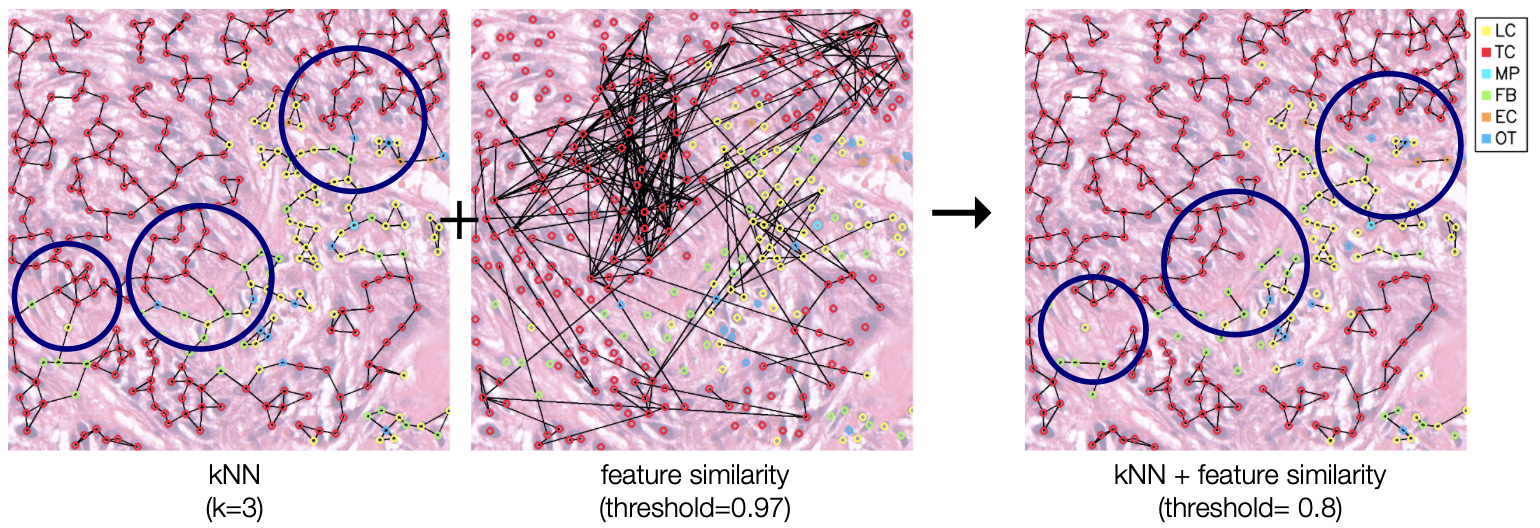
To represent the relationships between cells, we experimented with graphs created using K-Nearest Neighbors (KNN) and Feature Maps. This allowed us to visualize proximity-based connections and feature similarity, aiding in refining our model approach.
Final Idea
The enhanced model combines positional data with feature similarity, providing a more comprehensive perspective on cellular interactions. This fusion is achieved through graph structures and attention layers within the model.
Model Implementation & Architecture
Define the Solution
The Attention Based Cell Detection Enhancer model is structured around attention mechanisms, specifically leveraging Transformer architecture to utilize both spatial and feature-based relationships among cells.
Input Data
We use the original model’s feature map and prediction results as inputs. By incorporating these, we can effectively link cells that are spatially and feature-wise close to one another.
Model Architecture Development
Initially, we faced memory constraints, leading us to minimize the model’s complexity. Our final architecture employs Deformable Attention Layers to efficiently manage GPU memory and accurately attend to relevant cell points.

Experiment Results
Experiment Comparison
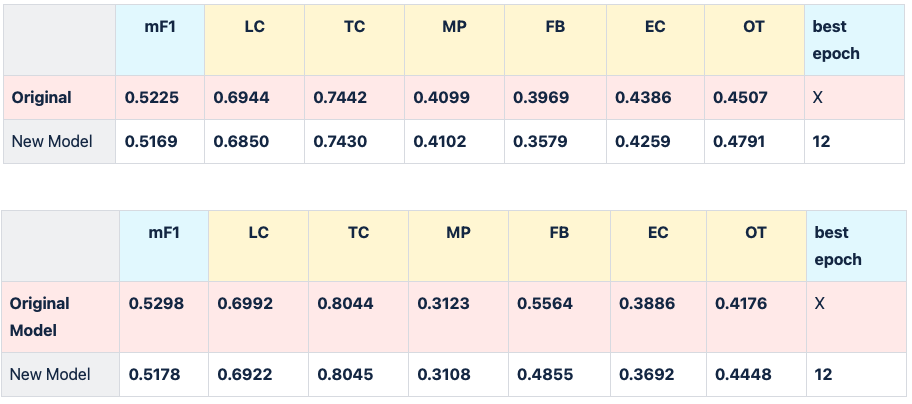
We conducted experiments with various configurations (number of layers, optimizers, schedulers, etc.). The enhanced model shows improved accuracy over the original model, particularly in accurately classifying cell types and reducing false positives.
Visualization Results
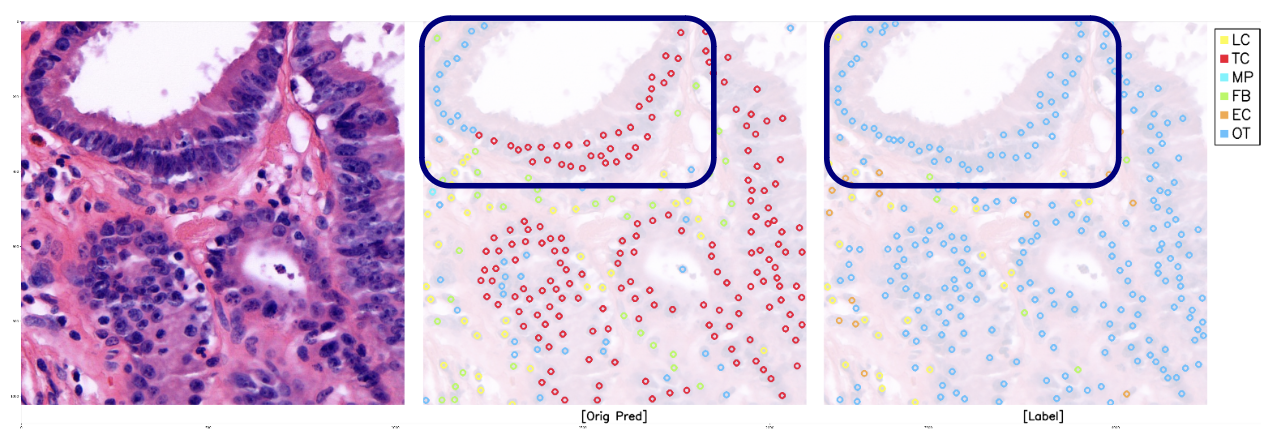
A visual comparison of the original and enhanced model results highlights the increase in accurate cell classification and the reduction of misclassified points.
Attention Map
Attention Map Analysis
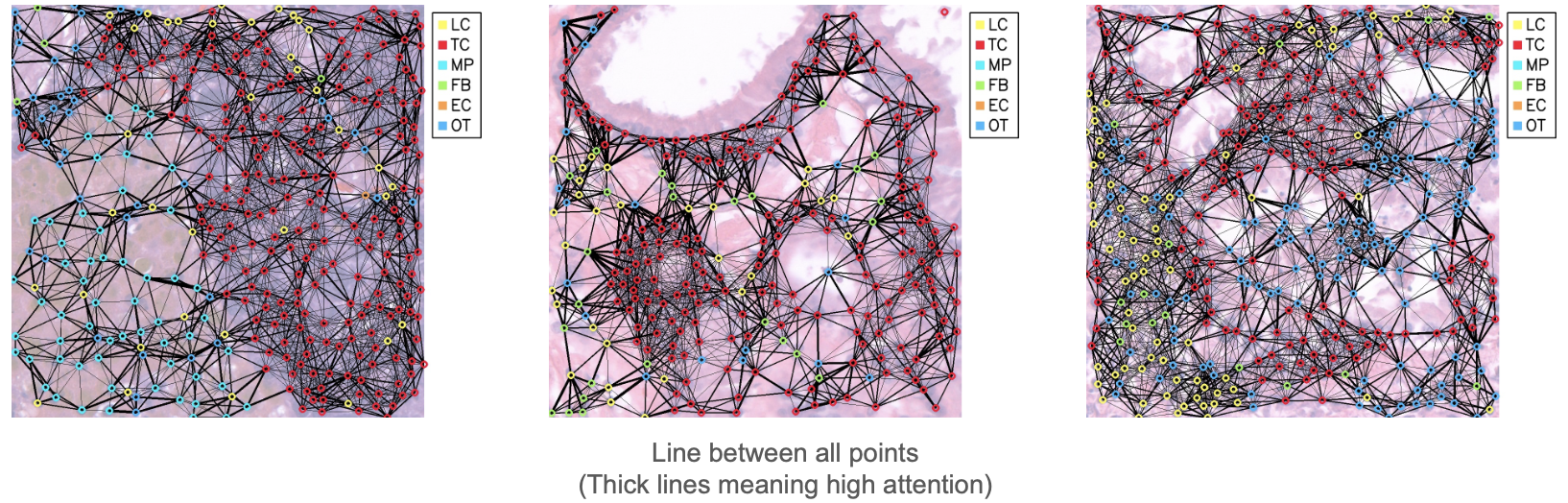
The attention map generated by the model shows the strength of connections between cells, with lines indicating high-attention connections. Initially, only a few cells exhibited strong attention. By adding an Attention Mask that focuses on closer cells, we achieved more relevant interactions and improved model performance.
Adding Attention Mask Based on Distance
To focus on biologically relevant interactions, we restricted attention to nearby cells. By masking out distant cells, the model could better highlight close interactions, leading to enhanced detection accuracy.
Effect of Attention Map
With the Attention Mask, the model now more effectively highlights cell clusters, producing results that align closely with ground truth.